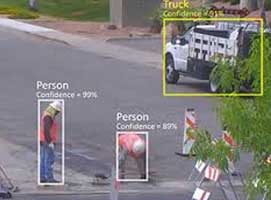
Video analytics can help find events and direct attention, but useful performance depends on the scene, configuration and response process. A claim of “AI” does not establish accuracy, identification or a guaranteed outcome. Begin with one defined operational task and test it in the actual environment.
Separate the functions
Basic motion detection responds to image changes. Object classification attempts to distinguish categories such as people or vehicles. Rules such as line crossing or intrusion add spatial and time conditions. Forensic search helps locate recorded material. Plate recognition and facial analysis add distinct privacy and accuracy considerations. Do not describe these as interchangeable capabilities.
Design a trial
Record camera position, lens, firmware, analytics version, zone, schedule and event settings. Test expected subjects at the limits of the useful scene. Include night operation, headlights, shadows, rain, foliage, delivery activity and partially obscured targets. Retain a manually reviewed sample so performance is compared with what actually happened.
| Measure | Question |
|---|---|
| Detected target events | How many known relevant events generated usable alerts? |
| Missed events | Which target conditions failed, and why? |
| Nuisance events | How much ordinary activity generated review work? |
| Operational delay | How long from event to receipt, review and authorized response? |
| Evidence quality | Does the associated recording include enough context before and after the event? |
Connect alerts to people
Specify who receives each alert, when the queue is staffed and what happens when the recipient is unavailable. Define verification, escalation, duplicate handling and closure. A notification sent to an unattended phone is not a complete response workflow. Avoid automatic accusations or adverse decisions based only on an algorithmic label.
Check integration and privacy
Determine whether processing occurs at the camera, recorder or hosted service, and whether metadata leaves the site. Confirm license requirements, retention, role restrictions and audit records. Audio and biometric features require separate organizational and legal review. Verify privacy masks in recordings and exports, not only on screen.
ONVIF Profile M and related profile documentation can help identify interoperability functions, but the exact camera and VMS combination must still be tested. A supported video stream does not guarantee that every analytics event is available.
Maintain performance
Re-test after changing cameras, software, illumination, racks or scene boundaries. Keep a configuration record and monitor both missed events and workload over time. Use the manufacturer comparison to apply the same trial to competing platforms and the planning guide to connect analytics with recording and response requirements.
Related NERSA reference
See NERSA’s analytics and motion-detection comparison for the corresponding applied reference.