Warehouse and logistics facilities present video-surveillance challenges that are very different from those of smaller commercial buildings.
Large interiors, high ceilings, loading docks, trailer yards, long exterior perimeters, constant vehicle activity, changing inventory and multiple employee or contractor entrances all affect how a surveillance system should be designed.
This educational guide explains the primary considerations businesses should evaluate when planning warehouse and logistics video surveillance.
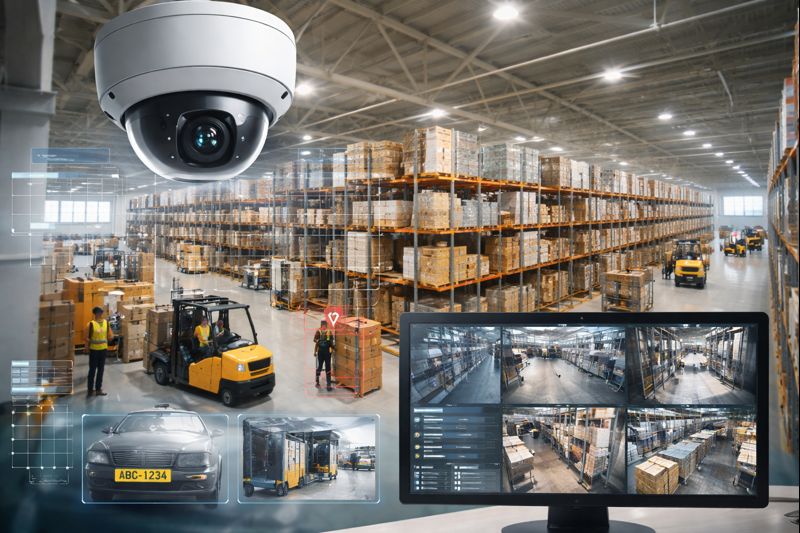
Start With the Surveillance Objective
The first question should not be:
How many cameras do we need?
A better question is:
What must we be able to see, detect or document?
Warehouse surveillance requirements commonly include:
- Employee and visitor entrances
- Shipping and receiving
- Loading docks
- Trailer yards
- Inventory areas
- High-value storage
- Forklift traffic
- Exterior doors
- Parking areas
- Gates
- Perimeter fencing
- Equipment yards
Each location can require a different camera strategy.
A camera intended to provide general warehouse-floor awareness may not provide enough detail to positively identify a person.
Likewise, a general exterior camera may observe vehicles entering a property but still be unable to capture usable license plates.
Define the objective before selecting the camera.
Warehouse Camera Placement
Camera placement is one of the most important elements of an effective surveillance system.
Important design considerations include:
- Mounting height
- Distance from the target
- Field of view
- Lens selection
- Available lighting
- Backlighting
- Racking and other obstructions
- Required identification detail
- Expected vehicle or pedestrian movement
High warehouse ceilings can make installation convenient while producing poor identification images if cameras are mounted too far from the activity being monitored.
Strategic lower mounting positions may therefore be appropriate around entrances, docks and other high-value locations.
Selecting Camera Types
Different warehouse environments may require several camera styles rather than one camera model throughout the facility.
Fixed Cameras
Fixed dome or bullet cameras are commonly used for:
- Entrances
- Hallways
- Loading docks
- Storage rooms
- Building exteriors
- Defined warehouse areas
They provide consistent coverage of predetermined areas.
Multi-Sensor Cameras
Multi-sensor cameras can provide several viewing directions from one mounting location.
They may work particularly well for:
- Large warehouse intersections
- Open production areas
- Exterior building corners
- Loading areas
- Large distribution floors
They can reduce blind spots while simplifying installation.
Panoramic and 360-Degree Cameras
Panoramic cameras provide broad situational awareness.
They may be useful in:
- Open warehouse spaces
- Staging areas
- Packing areas
- Large interior intersections
However, broad coverage should not automatically replace dedicated identification cameras.
PTZ Cameras
Pan-tilt-zoom cameras can provide flexible coverage of large areas.
Common applications include:
- Trailer yards
- Large parking areas
- Exterior storage
- Industrial campuses
Their effectiveness depends heavily on how they are operated and whether fixed cameras provide continuous coverage when the PTZ is looking elsewhere.
License Plate Recognition
Warehouses and distribution centers often need to document vehicles entering or leaving the property.
License plate recognition requires more than positioning a conventional camera toward a driveway.
Proper LPR design considers:
- Vehicle speed
- Capture distance
- Lane width
- Camera angle
- Mounting height
- Lighting
- Headlight glare
- Lens selection
- Exposure settings
Whenever license plate evidence is important, the capture point should be engineered specifically for that purpose.
Loading Dock Surveillance
Loading docks are among the most important surveillance locations in many logistics facilities.
Camera coverage may be used to document:
- Trailer arrivals
- Loading and unloading
- Product movement
- Driver activity
- Dock-door activity
- Shipping discrepancies
- Damaged freight
- Workplace incidents
A strong design may combine overview cameras with closer identification views.
The objective is to provide enough context to understand what occurred while also capturing useful details.
Trailer and Exterior Yard Surveillance
Exterior logistics areas can be difficult to protect because of their size, lighting conditions and vehicle movement.
System planning should evaluate:
- Fence lines
- Gates
- Trailer parking
- Employee parking
- Exterior equipment
- Remote storage
- Fueling areas
- Vehicle entrances
- Pedestrian access points
Long-range cameras, multi-sensor cameras, thermal technology or video analytics may be appropriate depending on the property.
AI Video Analytics
Modern video-surveillance systems can analyze activity rather than simply record it.
Depending on the platform, analytics may differentiate between:
- People
- Vehicles
- Objects
- Movement direction
- Restricted-area activity
- Line crossing
- Loitering
This can make recorded video easier to search and can potentially provide notification of defined security events.
Analytics work best when detection rules are carefully designed around the environment.
Excessively broad rules may generate large numbers of irrelevant alerts.
Recording and Video Retention
Warehouse surveillance systems can generate significant amounts of video.
Storage requirements depend on:
- Camera quantity
- Resolution
- Frames per second
- Compression
- Recording schedule
- Scene activity
- Required retention period
Recording architectures may include:
- Local network video recorders
- Dedicated servers
- Edge storage
- Cloud-managed systems
- Hybrid solutions
Retention should be calculated during system design rather than estimated after installation.
Network Infrastructure
Modern IP surveillance depends on the network supporting it.
A warehouse deployment may require:
- Cat6 cabling
- PoE network switches
- Fiber-optic backbone connections
- Equipment racks
- Network closets
- UPS backup
- Surge protection
- Network segmentation
Large facilities may require multiple network closets because copper Ethernet has practical distance limitations.
Fiber is frequently used to connect remote areas, separate buildings or intermediate network locations.
PoE Capacity
The number of available network-switch ports is only part of the design.
The available Power over Ethernet budget must also support the connected devices.
Higher-powered equipment can include:
- Multi-sensor cameras
- PTZ cameras
- Outdoor heated cameras
- Illuminators
- Specialized surveillance devices
Proper switch sizing helps avoid reliability problems as systems expand.
Integrating Video With Access Control
Video surveillance and access control can provide substantially more investigative value when used together.
An organization investigating a door event may need to determine:
- Which credential was presented
- Which door was accessed
- What time it occurred
- Who actually entered
- What happened immediately afterward
Associating access events with corresponding video can simplify that investigation.
Video-Verified Intrusion Detection
Video can also provide context when an intrusion or perimeter alarm occurs.
Instead of receiving only a sensor activation, an operator may be able to determine whether the event involves:
- A person
- A vehicle
- An animal
- Weather-related movement
- Normal employee activity
Careful system integration can therefore improve situational awareness and response.
Planning for Expansion
Warehouse facilities frequently change.
Businesses may add:
- New racking
- Additional dock doors
- New equipment
- Parking areas
- Additional warehouses
- Yard space
- New buildings
A surveillance system should therefore be designed with reasonable expansion capacity.
That may include additional:
- Network ports
- PoE capacity
- Fiber strands
- Rack space
- Storage
- Camera licenses
Planning for growth during the original deployment can be considerably easier than rebuilding infrastructure later.
Upgrading Existing Warehouse Camera Systems
An existing surveillance system does not always need complete replacement.
A professional evaluation can determine whether existing:
- IP cameras
- Cabling
- Fiber
- Network switches
- Servers
- Storage infrastructure
can continue to be used.
Modernization may instead focus on weak cameras, obsolete recording equipment, cybersecurity, storage capacity, video management software or AI capabilities.
Questions to Ask Before Installing Warehouse Video Surveillance
Before requesting proposals, document the answers to these questions:
- What areas must be monitored?
- Where is positive identification required?
- Are loading docks a primary concern?
- Is license plate capture required?
- Are exterior yards or trailers being monitored?
- How many days of recorded video are needed?
- Who needs remote access?
- Are multiple facilities involved?
- Should video integrate with access control or intrusion alarms?
- How much expansion is expected?
The clearer these requirements are, the more accurately a surveillance system can be engineered.
Warehouse Video Surveillance Planning
The most effective warehouse surveillance systems are not simply collections of cameras.
They are coordinated systems involving:
camera placement + network infrastructure + recording + storage + analytics + cybersecurity + integration + future expansion.
Warehouse Video Surveillance FAQ
What cameras work best in warehouses?
There is no single best camera. Fixed, multi-sensor, panoramic, PTZ, low-light and specialized cameras may each serve different purposes within the same warehouse.
Where should warehouse cameras be installed?
Typical locations include entrances, loading docks, shipping and receiving areas, high-value storage, warehouse aisles, trailer yards, gates, parking areas and building perimeters.
Are high-resolution cameras always better?
Not necessarily. Resolution is only one factor. Lens selection, lighting, mounting height, field of view and distance from the subject can be equally important.
Can warehouse cameras identify license plates?
They can when the system includes properly designed license plate capture. A general surveillance camera overlooking a driveway may not consistently provide readable plates.
Can existing warehouse cameras be upgraded?
Often yes. Existing IP cameras, cabling, fiber and network infrastructure may sometimes be retained while outdated components are modernized.
Can video surveillance integrate with access control?
Yes. Integration can associate door and credential events with corresponding video, providing additional context during investigations.
Should warehouse surveillance use cloud or local recording?
Both approaches can be appropriate. Camera count, bandwidth, retention requirements, remote access, cybersecurity policies and multi-site requirements should determine the architecture.
How much warehouse video storage is required?
Storage depends on camera count, resolution, frame rate, compression, recording method, activity levels and retention requirements. It should be calculated as part of the system design.
Continue the technical planning
Use the complete planning guide, camera and hardware hub, manufacturer comparison and acceptance worksheets to turn these site observations into testable requirements. Review privacy, audio, user permissions and incident preservation separately from camera coverage.
Related NERSA reference
See NERSA’s warehouse and logistics camera reference for the corresponding applied reference.