Warehouse video surveillance should be planned around the way the facility actually operates, not around a simple camera count.
A good system should help a business monitor entrances, loading docks, warehouse aisles, shipping and receiving areas, employee activity, exterior yards, high-value inventory, and other critical areas without creating unnecessary blind spots or excessive equipment.
This planning guide explains the major considerations businesses should evaluate before installing or upgrading a warehouse video surveillance system.
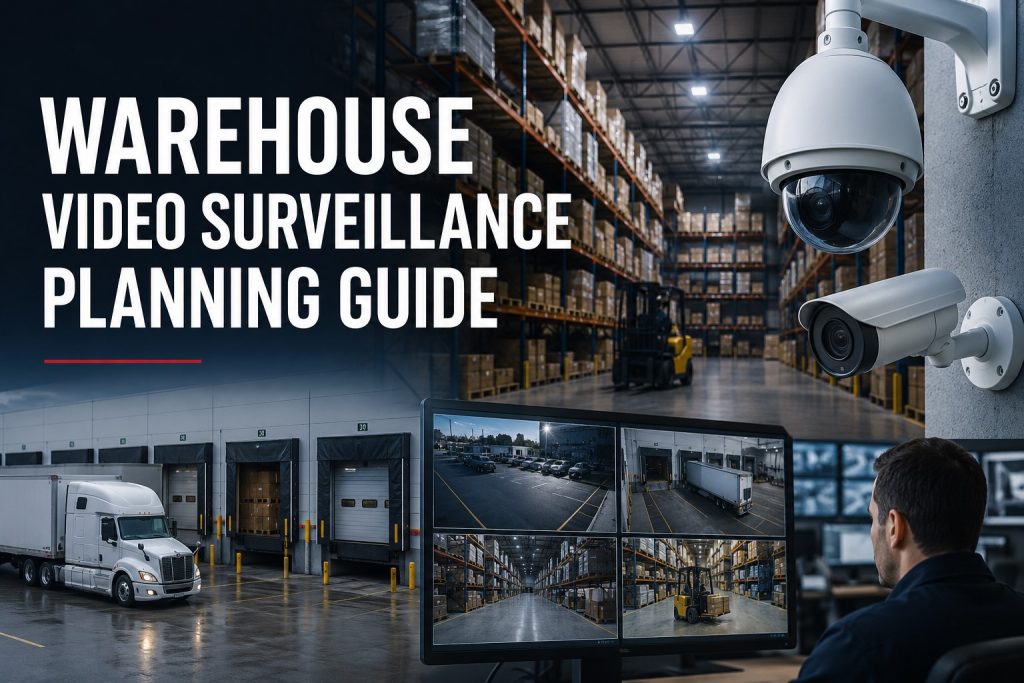
Start With the Facility Layout
The first step is understanding the building.
Warehouse video surveillance planning should consider:
- Building size
- Ceiling height
- Warehouse racking
- Loading dock locations
- Shipping and receiving areas
- Employee entrances
- Office areas
- Exterior doors
- Truck entrances
- Parking areas
- Exterior storage
- Fenced yards
- High-value inventory areas
- Restricted rooms
Large warehouses often require several different camera types because one camera design will not work equally well everywhere.
Define the Main Security Objectives
Before selecting cameras, determine what the system needs to accomplish.
Common goals include:
- Monitoring entrances and exits
- Reviewing loading dock activity
- Watching high-value inventory
- Monitoring employee entrances
- Reducing theft
- Investigating incidents
- Reviewing shipping and receiving activity
- Monitoring exterior yards
- Supporting intrusion alarm events
- Supporting access-control investigations
- Recording vehicle activity
The purpose of the system should guide camera placement, image quality, storage, and recording requirements.
Loading Dock Camera Planning
Loading docks are among the most important areas in many warehouse facilities.
Cameras may be used to monitor:
- Trailer doors
- Dock doors
- Loading activity
- Shipping activity
- Receiving activity
- Forklift traffic
- Employee movement
- Vehicle arrival and departure
Camera placement should provide useful views without being blocked by trucks, trailers, dock equipment, or open overhead doors.
A single wide-angle camera may provide general awareness, but additional cameras may be needed when identification or detailed incident review is important.
Warehouse Aisle Coverage
Long warehouse aisles can be difficult to monitor.
Planning should consider:
- Rack height
- Aisle length
- Lighting
- Obstructions
- Forklift traffic
- Product stacking
- Camera mounting height
Cameras mounted too high may provide broad coverage but limited detail.
Cameras mounted too low may be easier to obstruct.
The correct placement depends on whether the goal is general activity monitoring, identification, or detailed inventory review.
Employee Entrance Cameras
Employee entrances often benefit from dedicated video coverage.
These areas may include:
- Main employee entrances
- Side entrances
- Break-room entrances
- Warehouse access doors
- Restricted entrances
Video can provide additional context when reviewing access-control events or intrusion alarm activity.
The camera should be positioned to capture useful facial and directional information whenever practical.
Shipping and Receiving Areas
Shipping and receiving areas often involve:
- Drivers
- Warehouse employees
- Contractors
- Forklift operators
- Valuable goods
- Documentation
- Repeated vehicle traffic
Video surveillance can help businesses review activity before, during, and after shipments.
The system may need to capture both broad operational views and closer views of specific transaction areas.
High-Value Inventory Protection
Warehouses storing valuable or sensitive products may require additional camera coverage.
Possible areas include:
- Locked cages
- Tool rooms
- Electronics storage
- Parts storage
- Pharmaceutical storage
- High-value product aisles
- Restricted inventory rooms
These areas may benefit from dedicated cameras rather than relying only on general warehouse coverage.
Exterior Warehouse Coverage
Exterior surveillance may be needed around:
- Loading docks
- Truck courts
- Employee parking
- Visitor parking
- Trailer storage
- Fenced yards
- Gates
- Building entrances
- Exterior equipment
Outdoor camera planning should account for:
- Lighting
- Distance
- Weather
- Glare
- Vehicle headlights
- Mounting height
- Nighttime image quality
Exterior coverage should be designed around the specific area rather than assuming one camera can cover an entire yard.
Camera Resolution and Image Detail
Higher resolution does not automatically guarantee better surveillance.
Useful image quality depends on:
- Camera placement
- Distance
- Field of view
- Lighting
- Lens selection
- Compression
- Recording settings
A properly positioned camera with the correct lens can often provide better usable footage than a higher-resolution camera installed in the wrong location.
The system should be designed around the level of detail required at each location.
Wide-Angle Versus Focused Views
Wide-angle cameras are useful for general awareness.
Focused cameras are often better when identification or specific detail is required.
A warehouse may use:
- Wide-angle cameras for large areas
- Focused cameras at entrances
- Dedicated dock cameras
- Corridor or aisle views
- Exterior vehicle cameras
The best systems usually combine different camera views rather than trying to use one camera style everywhere.
Night and Low-Light Conditions
Many warehouses operate early in the morning, late at night, or around the clock.
Camera planning should evaluate nighttime conditions.
Important considerations include:
- Available exterior lighting
- Interior warehouse lighting
- Infrared capability
- Headlight glare
- Backlighting
- Shadows
- Changing lighting conditions
Testing nighttime image quality is especially important around truck entrances and loading docks.
Recording and Storage
Video storage should be planned around how long footage needs to be retained.
Retention requirements may depend on:
- Business policy
- Incident investigation needs
- Customer requirements
- Insurance requirements
- Available storage
- Camera resolution
- Recording method
- Frame rate
Storage calculations should be completed before the system is installed.
Adding cameras later without considering storage capacity can reduce retention time.
Continuous Recording Versus Motion Recording
Warehouse systems may use:
- Continuous recording
- Motion-based recording
- Event-based recording
- A combination of methods
Continuous recording provides a complete timeline but requires more storage.
Motion recording can reduce storage requirements but may miss activity if detection is poorly configured.
The recording method should match the importance of the area being monitored.
Network Infrastructure
Modern IP video systems depend heavily on network infrastructure.
Planning should consider:
- Network switches
- Power over Ethernet
- Available bandwidth
- Fiber connections
- Building distances
- Remote buildings
- Network security
- Backup power
Large warehouses may require additional network equipment or fiber connections to support cameras located far from the main equipment room.
Power Over Ethernet
Power over Ethernet allows many IP cameras to receive power and network connectivity through a single cable.
Planning should confirm:
- Available PoE capacity
- Switch capacity
- Cable distances
- Network room locations
- Future camera expansion
Insufficient PoE capacity can create problems when additional cameras are installed later.
Remote Buildings and Large Properties
Warehouses with detached buildings or large yards may require additional infrastructure.
Possible solutions may include:
- Fiber
- Wireless bridges
- Remote network switches
- Dedicated power
- Additional recording infrastructure
The best approach depends on distance, available pathways, network requirements, and environmental conditions.
Video and Access Control
Video surveillance can support access-control investigations.
For example, businesses may review:
- Credential activity
- Door activity
- Employee entrances
- After-hours entry
- Restricted-area access
Video provides additional context but does not replace access control.
Access records show which credential was used, while video may help determine what happened around the event.
Video and Intrusion Alarm Integration
Video can also provide additional information around intrusion alarm events.
A properly designed system may help businesses review:
- What happened before the alarm
- Which entrance was involved
- Whether activity continued
- Vehicle movement
- Movement inside the warehouse
This can improve incident review and help management better understand security events.
Remote Video Monitoring
Some warehouse facilities may benefit from remote video monitoring.
This can be useful for:
- Exterior yards
- Loading docks
- Restricted areas
- After-hours activity
- Equipment storage
- Vehicle entrances
Remote monitoring should be designed carefully around camera placement, lighting, network reliability, and response procedures.
Avoid Common Warehouse Camera Mistakes
Poor planning can create expensive problems.
Common mistakes include:
- Mounting cameras too high
- Using overly wide views
- Ignoring nighttime lighting
- Failing to plan storage
- Overlooking loading docks
- Ignoring employee entrances
- Installing cameras behind obstructions
- Failing to plan network capacity
- Not considering future expansion
- Using poor camera descriptions
The objective should be useful, reviewable footage rather than simply maximizing camera count.
Label Cameras Clearly
Camera names should make sense to employees and technicians.
Examples include:
- Loading Dock 3
- Main Employee Entrance
- Shipping Office
- Warehouse Aisle 7
- Rear Truck Gate
- High-Value Storage
Generic names such as Camera 1 or Camera 12 make investigations and service more difficult.
Plan for Future Expansion
Warehouse operations change.
A facility may later add:
- More docks
- Additional warehouse space
- New racking
- Exterior storage
- New entrances
- Additional buildings
- More cameras
- Access control
- Remote monitoring
Planning extra network capacity, storage, PoE capacity, and cable pathways can make future expansion easier.
When to Upgrade an Existing Warehouse Camera System
An older system may need attention when:
- Cameras provide poor image quality
- Nighttime video is unusable
- Retention is too short
- Cameras frequently fail
- The recorder is obsolete
- Remote access is unreliable
- Important areas are not covered
- The network cannot support expansion
- The system does not integrate with other security technologies
An upgrade does not always require replacing every camera.
Existing infrastructure should be evaluated before making that decision.
Warehouse Video Surveillance Planning Checklist
Before installing or upgrading a system, review:
- Building layout
- Loading docks
- Employee entrances
- Warehouse aisles
- Shipping and receiving
- High-value inventory
- Exterior yards
- Truck entrances
- Lighting
- Camera placement
- Recording requirements
- Storage retention
- Network capacity
- PoE capacity
- Remote buildings
- Future expansion
- Access-control coordination
- Intrusion-alarm coordination
A well-planned warehouse video surveillance system should provide useful coverage today while remaining practical to maintain and expand as operations change.
Learn More About Commercial Warehouse Video Surveillance
Businesses planning a new warehouse camera system or evaluating an existing installation should consider the complete property, operating schedule, network infrastructure, storage requirements, and security objectives before selecting equipment.
Document the design and test results
Use the system planning guide, hardware hub, manufacturer comparison and acceptance worksheets to record the selected views, retention, privacy controls and day/night evidence. Review the design after racks, loading positions or lighting change.
Related NERSA reference
See NERSA’s warehouse camera planning reference for the corresponding applied reference.